
How to Actually Get Good at Working with AI
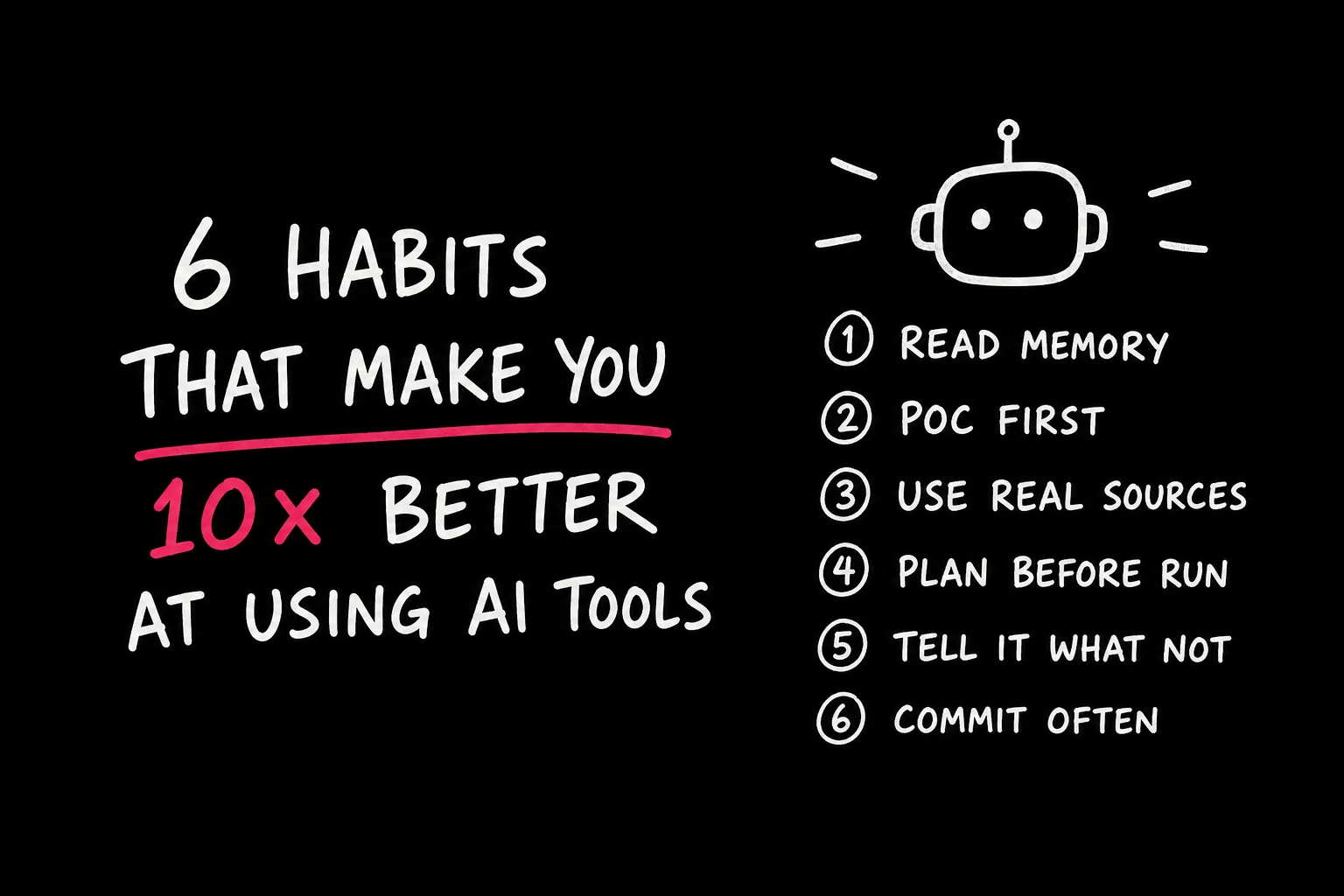
Nobody tells you this upfront: working with AI tools is a skill. Not prompting - that's a small part of it. The actual skill is knowing how to structure your sessions, how to feed context, when to slow down, and when to let it run.
These are the habits that made the biggest difference. They work across Claude, ChatGPT, Cursor, Windsurf, or whatever tool you're using today.
1. A Memory File is Useless Unless the AI Reads It Every Time
The most common advice is "keep a memory file in your project." Good advice. But incomplete.
Here's what actually happens: you create memory.md, write your stack, your decisions, your constraints. Then three sessions later the AI confidently tells you to deploy to Vercel when you're on a VPS. Because it never looked at the file.
The file existing is not enough. The AI needs to be told to read it.
Fix this in your CLAUDE.md, AGENTS.md, or .cursorrules:
Before every response, read memory.md. If something important changed in this session, update it.Now it's a reflex, not a suggestion. The AI checks it without you asking. And it updates it when it learns something new about your project.
What goes in memory.md:
Not your full spec. Not your README. Just the things the AI keeps getting wrong.
2. Proof of Concept First, Always
This is the most expensive mistake in agentic coding: jumping straight to the full implementation.
You describe a feature. The AI writes 400 lines across 6 files. You look at it and realize the approach is wrong. Now you're either accepting bad code or starting over. Both are expensive.
The fix is simple: ask for the smallest possible version first.
Building a website? Ask for a single index.html with no JS. Approve the direction, then build for real.
New feature? Ask for the minimal working version with no edge cases. Does it go in the right direction? Then continue.
Debugging? Ask for the simplest possible fix, not the most complete one. Validate it works, then clean it up.
This is not about being cautious. It's about the cost of wrong direction being much higher than the cost of one extra step. A 50-line PoC that shows you the approach is wrong saves you hours.
3. Clone the Repos Your Project Depends On
AI tools hallucinate APIs. They confidently write code for a method that doesn't exist, or for a version that's three major releases old.
The fix: clone the actual source code of the libraries you use and reference it in your instructions.
# In AGENTS.md or CLAUDE.md
When you need to understand how PocketBase works, look at /path/to/pocketbase-source.
Don't guess the API. Read it.
This sounds like extra work. It saves you hours of debugging phantom methods.
Especially useful for:
- Libraries with breaking changes between versions
- Any SDK you're using in an unusual way
- Internal packages your company maintains
The AI reads the actual code and gives you answers that match reality.
4. Break the Task Before Running It
One of the highest-leverage habits: before asking the AI to do something, ask it to explain what it's going to do.
Don't write anything yet. Tell me how you'd approach this.This takes 30 seconds. It catches wrong assumptions before they become wrong code. The AI often reveals a misunderstanding in its plan that would have cost you 20 minutes to untangle after the fact.
Once you approve the plan, let it run. The directional cost is paid once, not after.
5. Tell It What You Don't Want
Most prompts describe what you want. Few describe what you don't want.
These are not the same thing. "Add dark mode support" and "Add dark mode support without touching the existing CSS variables" produce very different results.
Negative constraints are cheap to write and expensive to discover after the fact.
Before any significant change, add one line:
Don't add new dependencies.
Don't modify the auth logic.
Don't change the database schema.
Keep the existing file structure.
The AI treats hard constraints seriously. Use them.
6. Commit at Every Checkpoint
This is obvious in theory and ignored in practice.
Agentic sessions are long. The AI makes a change that works, then makes another that breaks something earlier. Without commits, you're debugging a moving target.
Commit every time something works. Not when the feature is done. When anything works.
The cost of an extra commit is zero. The cost of untangling 90 minutes of changes with no rollback point is real.
Short sessions with clear checkpoints beat long sessions with "I'll commit when it's done."
The Pattern Underneath All of This
Each of these habits solves the same problem: AI tools start fresh every session and drift over long ones.
Memory file - prevents context drift between sessions. PoC first - prevents directional drift at the start. Repo clones - prevents hallucination drift on APIs. Task breakdown - catches drift before it starts. Negative constraints - bounds the drift space. Commits - lets you recover from drift.
You're not just prompting. You're managing context over time. The better you get at that, the better the output gets.
The tools keep improving. The habits matter more than the tool.